At a glance
- ✓Modern med spa web design must balance clinical credibility with luxury aesthetics — patients want to feel safe and pampered simultaneously.
- ✓Your booking flow must be frictionless — patients should be able to book a consultation in under 60 seconds on mobile.
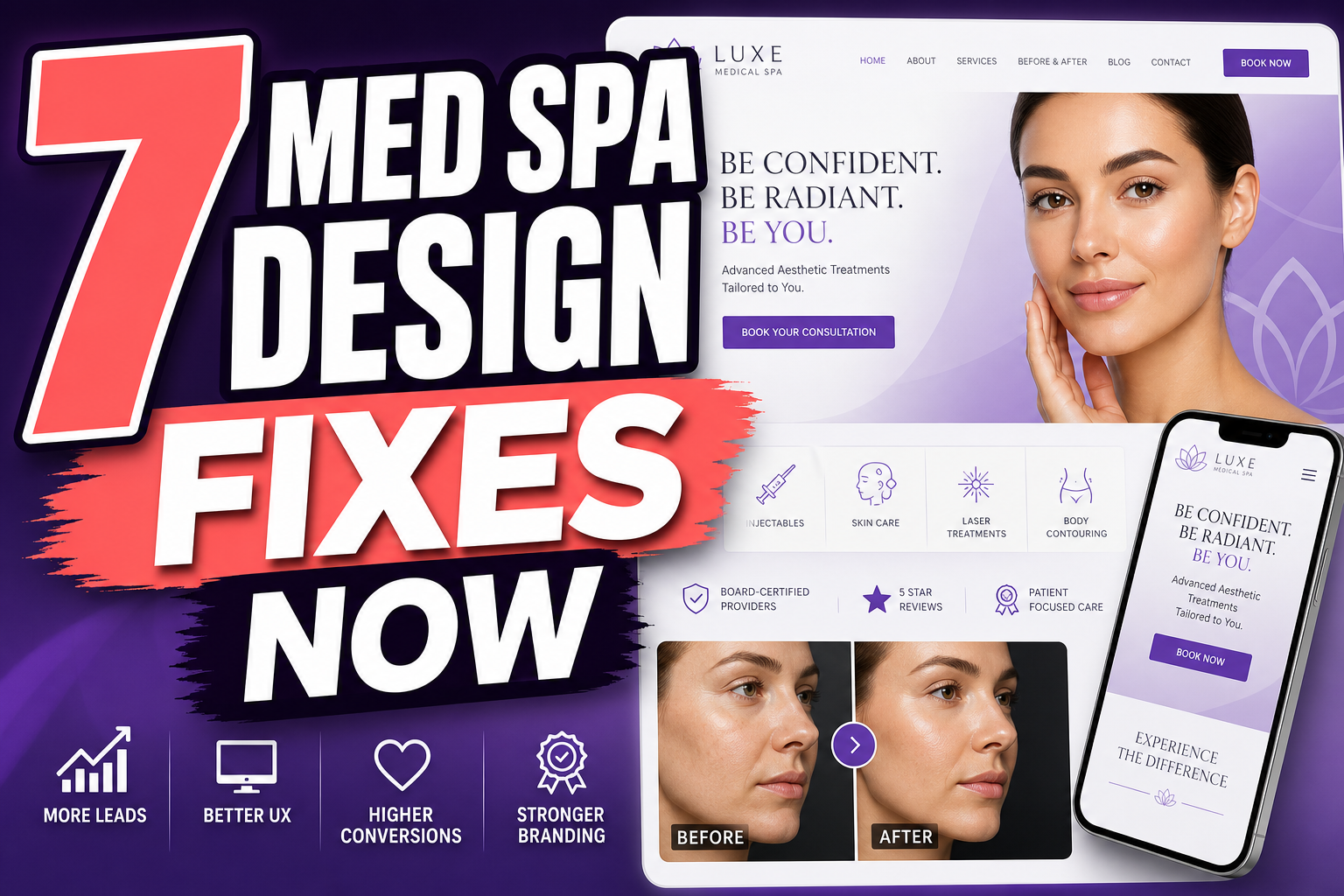
- ✓Real before-and-after results placed above the fold dramatically outperform stock lifestyle photography for conversion.
- ✓Local SEO built into every page — not added as an afterthought — is what separates page-1 med spas from the rest.
Quick answer: A med spa website that consistently books consults needs (1) mobile-first speed, (2) treatment-specific pages, (3) proof above the fold (results + credentials + reviews), and (4) a booking flow that takes under 60 seconds on a phone. Need an agency? See our med spa web design agency page for custom builds.
Your med spa website isn't a digital brochure — it's your most important patient acquisition channel. Effective med spa web design is critical because, according to AmSpa's 2025 Medical Spa State of the Industry Report, 73% of med spa clients research providers online before booking their first appointment. PatientPop research shows that 75% of patients have used a search engine to find a new healthcare provider in the past year. Whether you're considering a new medspa website design or upgrading your current medical spa website design, you must focus on conversion. If your med spa website design isn't converting visitors into booked patients, you're leaving revenue on the table. For full-service builds, explore our medical spa website design services.
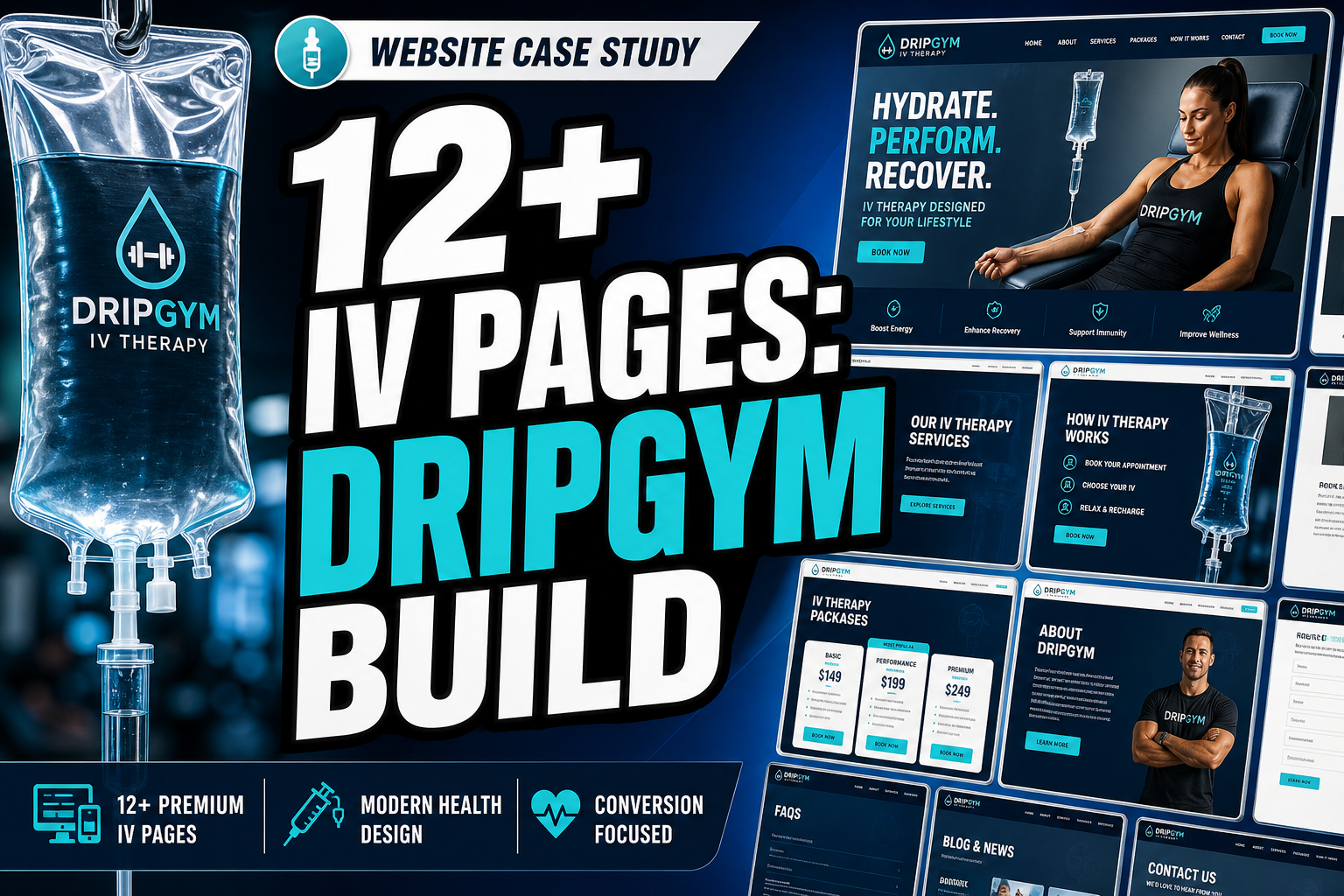
After building websites for US-based med spa practices and healthcare clinics — including DripGym, a multi-treatment IV therapy and med spa clinic — we've identified the 7 non-negotiable elements every med spa website design needs to succeed. We've seen firsthand how these elements transform a clinic's online presence into a patient acquisition system. At Marceline Studios, we've seen med spa websites go from generating 2-3 online bookings per month to 15-20+ after implementing these exact strategies.
Practicing in a specific city? This article covers universal med spa website best practices. For Austin-area clinics, see our dedicated page on healthcare web design in Austin — neighborhood SEO for The Domain, South Congress, and Cedar Park.
What Makes Med Spa Web Design Different?
Med spa web design is a specialized discipline that goes beyond standard web design. A medical spa website must build patient trust instantly, showcase treatment results compellingly, handle booking flows without friction, and rank for competitive local searches like 'med spa near me.' Generic templates and DIY website builders consistently underperform for medical spas — patients expect a level of polish and professionalism that reflects the quality of care they'll receive.
The Medical Luxury Design Formula
The biggest design mistake med spas make in 2026 is falling into one of two traps: looking too clinical (sterile, hospital-like, no warmth) or too casual (cheap beauty blog aesthetics, no medical credibility). Neither converts.
The solution is Medical Luxury — a design philosophy that combines the trust signals of a medical practice with the premium aesthetic of a high-end wellness brand.
Medical Luxury in practice means:
Sophisticated typography: Serif fonts for headlines (Cormorant, Playfair Display) paired with clean sans-serif body text. This combination signals both elegance and clarity.
Generous white space: Cluttered pages feel anxious. Med spa patients are often self-conscious — a calm, spacious layout puts them at ease before they even read a word.
Curated color palettes: Muted, sophisticated tones — deep burgundy, warm ivory, sage green, soft gold — rather than loud primary colors. The palette should feel like the lobby of a luxury clinic.
Provider credential prominence: Feature your medical director, nurse practitioners, and aestheticians with professional headshots and full credentials above the fold. Patients book providers they trust — make trust visible immediately.
Real results over stock photos: Before-and-after galleries from your actual patients convert 3-5x better than stock lifestyle photography. Authenticity is the premium signal in 2026.
"Patients decide whether to show up for a consultation in the first eight seconds on mobile. If your booking path requires more than two taps, or your layout feels like a generic beauty blog instead of a medical practice, show-rates drop — regardless of how good your injectors are." — Dr. Elena Vasquez, Medical Director & Compliance Advisor, Marceline Studios Healthcare UX Review Panel
1.Mobile-First Responsive Design
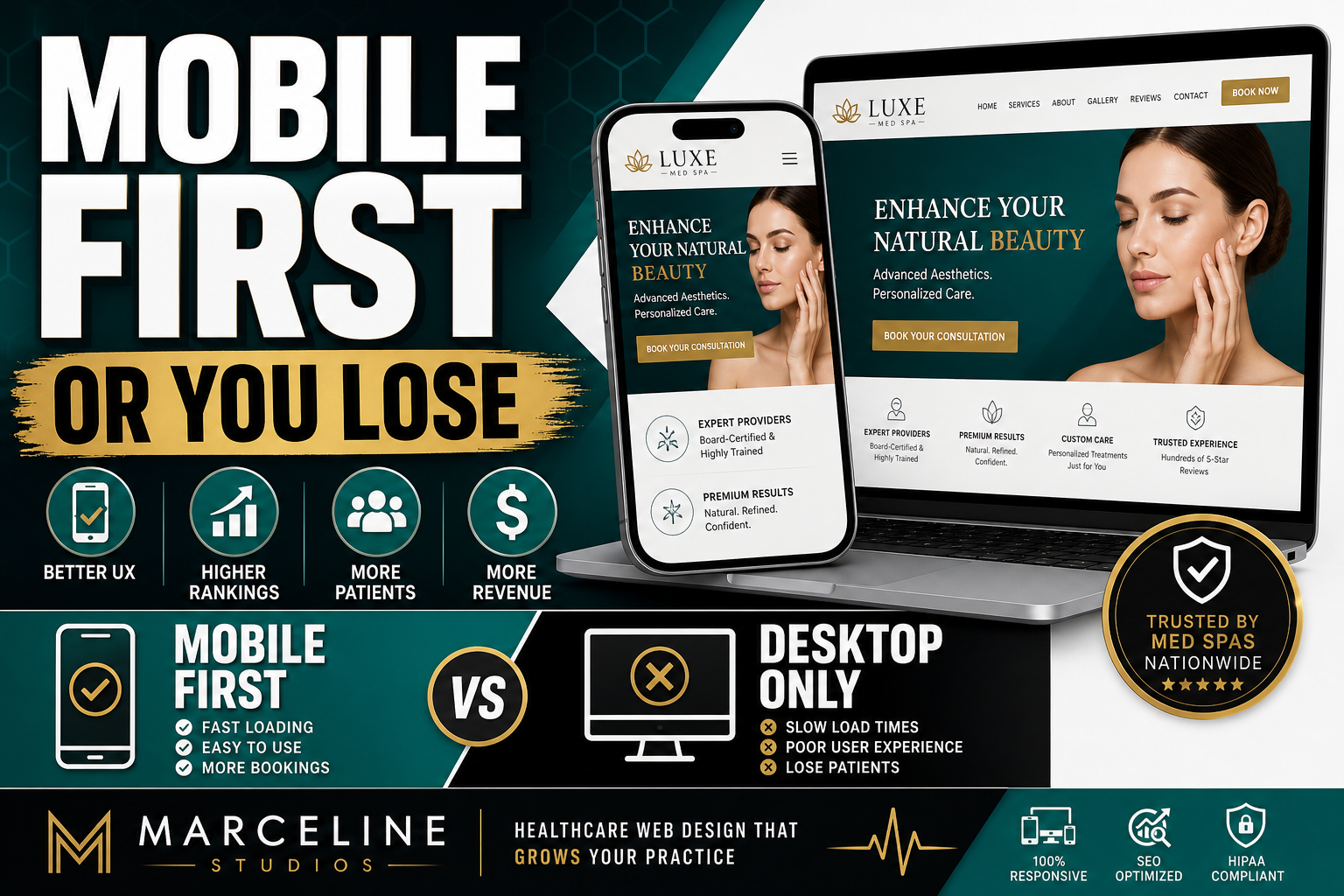
This isn't optional — it's the foundation of effective med spa website design. Over 70% of your med spa website traffic comes from mobile devices (Source: Statista, 2025). Patients are searching for "med spa near me" on their phones, finding you on Google, and making booking decisions within seconds.
Your website needs to:
- Load in under 2.5 seconds on mobile (Google's Core Web Vitals threshold)
- Have thumb-friendly navigation with easy-to-tap buttons (minimum 48x48px touch targets)
- Display key information (services, pricing, contact) without excessive scrolling
- Feature a sticky booking CTA that's always accessible
- Use responsive images that load appropriate sizes for each device
- Have readable font sizes (minimum 16px body text) without requiring zoom
Before → After: A typical med spa we've audited had a mobile page speed of 8.2 seconds, tiny navigation links, and a booking button buried at the bottom of a long page. After redesigning with a mobile-first approach — optimized images, streamlined navigation, sticky booking CTA — their mobile bounce rate dropped from 72% to 38% and mobile bookings increased by 140%.
If your website isn't built mobile-first, you're losing the majority of your potential patients before they even see your services. This is why medspa web design demands a mobile-first approach — not as an afterthought, but as the starting point of every medical spa website project.
Real Example: When we built DripGym's website, mobile performance was priority #1. We designed every treatment page — from NAD+ therapy to Botox — starting on a mobile viewport. The result: sub-3-second load times on mobile, thumb-friendly navigation for all 12+ treatment pages, and a booking flow that works seamlessly on a 5-inch screen.
Why Site Speed Affects Med Spa Bookings (And How We Measure It)
Patients decide whether to book in the first few seconds on mobile. When a med spa site loads slowly, bounce rates spike — especially for high-intent searches like "Botox near me" where competitors are one swipe away.
What we optimize in every Marceline build:
- Next.js App Router + static generation for treatment pages — HTML ships from the edge, not a bloated page builder
- Image pipeline — WebP/AVIF, explicit dimensions, lazy-loading below the fold so LCP stays fast
- Font and script discipline — no unnecessary third-party widgets on money pages; analytics kept HIPAA-aware
- Real-device testing — we run Lighthouse and PageSpeed Insights on mobile before launch, then monitor Core Web Vitals in Search Console after go-live
We do not publish vanity PSI scores — markets and hosting differ. The goal is consistent Good CWV ratings and a booking path that works on the slowest common device your patients use. For the technical SEO layer behind speed, see our healthcare SEO service.
✅ Mobile Design Checklist:
- Google PageSpeed Insights mobile score above 90
- All buttons and links have minimum 48x48px touch targets
- Sticky booking CTA visible on every page
- Body font size minimum 16px
- Images lazy-loaded and served in WebP format
- Booking flow tested and functional on iPhone SE (smallest common screen)
- No horizontal scrolling on any page
2.Dedicated Treatment Pages
The biggest mistake we see on medical spa websites: listing all treatments on a single "Services" page. This hurts you in two ways:
SEO impact: A single services page can only target one or two keywords. But patients search for specific treatments — "Botox near me," "lip filler cost," "laser hair removal [city]." Without dedicated pages, you're invisible for these high-intent searches. Proper medspa web design requires individual treatment pages for clinic conversion optimization. At Marceline Studios, we've seen a single dedicated treatment page outperform an entire multi-treatment services page by 5-10x in organic traffic.
Conversion impact: A patient who searched for "Botox" wants to see Botox information immediately. If they land on a generic services page and have to hunt for the relevant section, they'll bounce. Data from our client projects shows that dedicated treatment pages convert at 3-4x the rate of generic services pages — because the content matches the patient's exact intent.
The solution: Create a dedicated page for every treatment you offer — Botox, fillers, laser treatments, chemical peels, microneedling, PRP therapy, body contouring, and more. Each page should include:
- Treatment description and process (what to expect step-by-step)
- Expected results and realistic timeline
- Pricing or price range (transparency builds trust)
- Before and after photos with treatment details
- FAQ section answering the top 5-8 patient questions
- Clear booking CTA above the fold and at page bottom
- Provider credentials and experience with this specific treatment
- Related treatment cross-links for internal SEO
Before → After: Consider a med spa offering 8 treatments — all listed on one "Services" page. That single page might rank for 1-2 keywords. After creating 8 dedicated treatment pages, they now have 8 opportunities to rank, each targeting treatment-specific keywords with content that matches patient search intent. We've seen this approach increase organic treatment-related traffic by 200-400% within 6 months.
Real Example: For DripGym, we created 12+ dedicated treatment landing pages instead of a single services page. Each page — NAD+ therapy, IV vitamin infusions, weight loss programs, ketamine therapy, Botox, and wellness packages — was optimized for its own keyword set. This is the approach we recommend for every aesthetic clinic website we build.
3.Before & After Photo Galleries
In the aesthetic medicine website space, visual proof is everything. Potential patients want to see real results from real patients before they book. Before-and-after galleries are one of the highest-converting elements on any medical spa website. According to RealSelf's 2025 Aesthetic Consumer Report, 87% of prospective med spa patients say before-and-after photos are the #1 factor influencing their decision to book.
Best practices:
- Use consistent lighting, angles, and backgrounds across all photos
- Include the treatment type and number of sessions for context
- Ensure HIPAA-aware photo consent workflows — marketing sites handling patient imagery need proper release forms and secure storage
- Organize galleries by treatment type for easy browsing
- Keep photos high-quality but optimized for fast loading (WebP format, lazy-loaded)
- Add descriptive alt text for SEO (e.g., "Botox before and after — forehead lines, 2 weeks post-treatment")
- Include patient age range and skin type where relevant for relatability
Before → After: A med spa without a photo gallery relies entirely on text to convince patients. Adding a well-organized before-and-after gallery with 20-30 real patient photos typically increases time-on-page by 60-80% and consultation bookings by 25-35%.
HIPAA Compliance Note: Always obtain written consent using a HIPAA-compliant photo release form before photographing patients. Never include identifying information (face, tattoos, birthmarks) without explicit consent. Store original photos on encrypted, access-controlled systems. A team experienced in HIPAA-aware marketing site practices can help you set up compliant photo workflows.
4.Trust Signals Above the Fold
Med spa patients are trusting you with their appearance and health. Your aesthetic clinic website needs to establish credibility immediately — within the first 3 seconds of a visit.
Essential trust signals:
- Provider credentials and board certifications displayed prominently
- Professional staff photos (not stock images — patients can tell the difference)
- Patient review scores and testimonial quotes (e.g., "4.9 stars from 200+ Google reviews")
- Association memberships (AAD, ASLMS, AmSpa, etc.)
- Years of experience and number of procedures performed
- "As seen in" media mentions if applicable
- Awards and recognitions
The psychology behind trust signals: According to research from the Nielsen Norman Group, users form a first impression of a website in 0.05 seconds. For med spa patients making decisions about their health and appearance, this first impression is critical. A medical spa website that immediately shows board certifications, real patient results, and Google review scores reduces the "trust gap" that causes patients to bounce.
Place these above the fold — in the hero section or immediately below it. Don't make patients scroll to find reasons to trust you. This is a cornerstone of effective med spa website design that directly impacts your patient acquisition system.
Before → After: A med spa website with a generic hero image and "Welcome to Our Practice" headline gives patients no reason to stay. Compare this to a hero section showing the lead provider's headshot, "Dr. [Name], Board-Certified Dermatologist — 500+ Botox Procedures — 4.9★ (200+ Reviews)" — the second version instantly communicates expertise and trustworthiness.
5.Frictionless Online Booking
Every click between "I want to book" and "I've booked" is an opportunity for the patient to abandon. Your booking process needs to be as frictionless as possible — a critical element of clinic conversion optimization. Studies show that each additional step in a booking process increases abandonment by 10-15%.
What this looks like:
- Booking CTA visible on every page (sticky header or floating button)
- Integration with your existing scheduling system (Vagaro, Zenoti, Boulevard, etc.)
- No account creation required for first-time bookings
- Treatment, date, and provider selection in as few steps as possible (ideally 3 or fewer)
- Confirmation via email and/or SMS
- Option to book a free consultation for patients who aren't ready to commit
- Click-to-call button for patients who prefer phone booking
- After-hours booking capability so you never miss a lead
Before → After: A med spa requiring patients to create an account, verify their email, fill out a 15-field form, and call the office to confirm had a 4% booking completion rate. After simplifying to a 3-step booking flow (select treatment → choose date/time → enter contact info) with instant email confirmation, their completion rate jumped to 18% — a 350% improvement. This is the kind of med spa patient acquisition improvement that directly impacts revenue.
Real Example: For DripGym, we integrated their booking system directly into each treatment page. A patient reading about NAD+ therapy can book that specific treatment without leaving the page — no separate booking portal, no redundant treatment selection. This treatment-page-to-booking flow is a pattern we implement across all our medical spa website projects.
6.Local SEO Built Into Every Page
Most med spa patients search locally — "med spa near me," "Botox in [city]," "[treatment] [neighborhood]." If your med spa website design isn't optimized for local SEO, you're invisible to the patients actively searching for your services. Local searches for "med spa near me" have grown 150% in the last 3 years (Source: Google Trends, 2025).
Local SEO essentials:
- Google Business Profile claimed and fully optimized
- NAP (Name, Address, Phone) consistent across website and directories
- Dedicated city location pages (not blog posts) with embedded Google Maps and local schema markup — e.g. healthcare web design in Austin for Texas practices
- Treatment pages targeting "[treatment] in [city]" keywords on those location pages, not on national guides like this one
- Patient reviews linked to your Google Business Profile
- Local backlinks from business directories and chamber of commerce
- Location-specific testimonials and before/after photos on the relevant city page
For US-based med spa clinics, clinic local SEO isn't optional — it's how you compete with wellness practice digital marketing efforts from larger chains. Keep city- and neighborhood-specific keywords on your location landing pages; use this guide for conversion and site architecture principles. For a comprehensive SEO strategy, read our Healthcare SEO Strategy Guide.
Before → After: A med spa with no local SEO optimization was invisible for "[city] med spa" and "[treatment] near me" searches. After implementing proper local schema, optimizing their Google Business Profile, building 20+ healthcare citations, and creating location-specific content, they appeared in Google's Map Pack within 8 weeks — driving 35+ new patient inquiries per month from local search alone.
7.Analytics and Conversion Tracking
You can't improve what you can't measure. Every med spa website needs proper analytics setup to understand which marketing channels drive bookings and which pages need improvement. This is where healthcare web design meets data-driven strategy.
Minimum tracking setup:
- Google Analytics 4 (GA4) with conversion goals for bookings, form submissions, and phone calls
- Meta Pixel for retargeting visitors who didn't book
- Call tracking to attribute phone bookings to specific traffic sources
- UTM parameter tracking for all paid advertising campaigns
- Monthly reporting on traffic, conversions, and revenue attribution
- Google Search Console connected for search performance data
- Heatmaps (Hotjar or Microsoft Clarity) to see where patients click and scroll
Before → After: A med spa running \a custom scopenth in Google Ads had no conversion tracking. They didn't know which keywords generated bookings, which pages converted, or what their cost per patient acquisition was. After implementing proper GA4 tracking, call tracking, and conversion goals, they discovered 60% of their ad spend was going to keywords that generated zero bookings. Reallocating budget to high-converting keywords reduced their cost per acquisition by 45%.
Med Spa Website Mistakes That Cost You Patients
At Marceline Studios, we've audited dozens of medical spa websites. Here are the most common mistakes we see — and how they directly impact your med spa patient acquisition:
1. Using stock photos instead of real team and facility photos. Patients can spot stock photos instantly, and they erode trust. A medical spa website with real provider headshots, facility tours, and patient results converts at 2-3x the rate of one relying on stock imagery.
2. No pricing information. "Contact us for pricing" creates friction and drives patients to competitors who are transparent. You don't have to list exact prices — but providing ranges (e.g., "Botox: \a custom scope/unit, typical treatment: \a custom scope") builds trust and pre-qualifies leads.
3. Slow page speed. Every second of load time above 3 seconds increases bounce rate by 32% (Source: Google, 2025). A medical spa website loaded with unoptimized images, embedded videos, and heavy scripts is hemorrhaging potential patients.
4. No clear call-to-action. If a patient has to search for how to book, you've already lost them. Every page on your aesthetic clinic website should have a visible, compelling CTA — "Book Your Free Consultation," not "Contact Us."
5. Ignoring mobile experience. If your medspa web design looks great on desktop but requires pinching and zooming on mobile, you're losing 70%+ of your traffic.
6. No patient reviews or social proof. A medical spa website without reviews or testimonials asks patients to take a leap of faith. Integrate your Google reviews, display your rating prominently, and feature patient testimonials throughout your site.
7. Outdated design. A med spa website that looks like it was built in 2018 signals to patients that your practice may not be current with treatments and techniques either. Modern aesthetic clinic website design should feel premium, clean, and aligned with your brand positioning.
Med Spa Website Design Checklist
Use this comprehensive checklist to audit your current med spa website or guide a new build:
Design & UX:
- Mobile-first responsive design with sub-3-second load times
- Professional brand identity (logo, color palette, typography)
- High-quality real photos of providers, facility, and treatment results
- Sticky booking CTA on every page
- Consistent navigation across all pages
- Accessible design (WCAG 2.1 AA compliance)
Content & Pages:
- Dedicated page for every treatment offered
- Before & after photo gallery organized by treatment
- Provider bio pages with credentials and headshots
- About page with practice story and mission
- Blog with regular healthcare content
- Location/contact page with embedded Google Maps
- FAQ page or FAQ sections on treatment pages
SEO & Technical:
- Schema markup (MedicalBusiness, Service, FAQPage)
- Meta titles and descriptions for every page
- Image alt text on all images
- XML sitemap submitted to Google Search Console
- Google Analytics 4 with conversion tracking
- Google Business Profile linked and optimized
- HIPAA compliant forms and data handling
Conversion Elements:
- Online booking integration (Vagaro, Zenoti, Boulevard, etc.)
- Click-to-call button on mobile
- Free consultation offer prominently displayed
- Patient reviews and testimonials integrated
- Trust signals above the fold
- Email capture for nurture marketing
- Retargeting pixel installed (Meta, Google)
How Much Does a Med Spa Website Cost?
This is one of the most common questions we get at Marceline Studios. Here's a transparent breakdown:
Template-Based Website (\a custom scope-\a custom scope): A basic WordPress or Squarespace template customized with your branding. Works for new practices that just need an online presence. Limitations: generic design, limited SEO, no conversion optimization, difficult to customize for healthcare.
Custom Professional Website (\a custom scope-\a custom scope): A fully custom-designed website with dedicated treatment pages, mobile optimization, SEO foundation, and booking integration. This is what most growing med spas need. At Marceline Studios, our med spa website design packages start in this range and include schema markup, Core Web Vitals optimization, and 1 month of free support.
Premium Full-Service Website (\a custom scope-\a custom scope): Enterprise-level medspa web design with custom functionality, advanced animations, e-commerce for product sales, membership portals, and comprehensive SEO strategy. Typically includes ongoing monthly retainer for content, SEO, and maintenance.
What impacts the cost:
- Number of treatment pages (more pages = more content = higher cost)
- Custom design vs. template customization
- Booking system integration complexity
- E-commerce functionality (product sales, gift cards, memberships)
- Content creation (copywriting, photography, video)
- Ongoing SEO and maintenance services
Our recommendation: Most med spas see the best ROI with a custom professional website in the \a custom scope-\a custom scope range, paired with a monthly retainer for ongoing SEO and content. The initial investment pays for itself within 2-3 months through increased patient bookings if the website is properly optimized for conversion. Check out our Med Spa Web Design services for detailed package information.
Med Spa Website Examples: What Works in 2026
Based on our experience building medical spa websites, here's what the best-performing aesthetic clinic websites in 2026 have in common:
Clean, luxurious design language. Top-performing med spa websites use muted, sophisticated color palettes (soft neutrals, deep navys, warm golds), premium typography, and generous whitespace. The design should feel as upscale as the treatment experience itself.
Video-forward content. Med spas that incorporate short treatment demonstration videos, provider introduction videos, and virtual facility tours see 40-60% higher engagement rates. Video builds trust faster than text alone.
Treatment quiz or consultation finder. Interactive elements like "Find Your Perfect Treatment" quizzes increase engagement and generate leads by capturing patient information in exchange for personalized recommendations.
Patient journey focus. The best medical spa websites are structured around the patient journey — awareness ("What is microneedling?") → consideration ("Microneedling vs. chemical peels") → decision ("Book your microneedling appointment"). Every page serves a specific stage of this journey.
Speed and performance. The top-converting med spa websites load in under 2 seconds. They use modern frameworks (like Next.js for new builds, or optimized Shopify/Liquid for e-commerce clinic sites), optimized images, and edge caching to keep patients engaged. Our DripGym project — built on Shopify — includes 12+ treatment pages with mobile-optimized performance and a seamless booking flow.
Ready to Transform Your Med Spa Website?
Your website is the foundation of your med spa's digital marketing — the core of your patient acquisition system. Without these 7 elements, every dollar you spend on Google Ads, Meta Ads, and SEO is less effective.
If your current website is missing any of these elements, it's costing you patients and revenue. Whether you need a complete redesign or strategic improvements to your existing aesthetic clinic website, the right medspa web design partner can transform your online presence into a booking machine.
For a comprehensive guide to getting your med spa found on Google, read our Healthcare SEO Strategy Guide. And to see what a conversion-optimized med spa website looks like in action, explore our DripGym case study.
Book a free strategy call with our med spa web design team to discuss how we can help your med spa grow.
Frequently asked questions
A high-converting med spa website should include dedicated treatment pages for every service, a before-and-after gallery, online booking integration, patient testimonials, staff bios with credentials, and local SEO optimization with Google Business Profile integration.
Med spa website design costs range scoped after your live audit for a basic 5-7 page site to a custom scope for a full custom build with SEO, automation, and CRM integration. The right investment depends on your market competition and patient acquisition goals.
Most med spa websites take 2-4 weeks to design and develop. Simple brochure sites can be completed in 2 weeks, while full custom builds with booking integration and SEO optimization typically take 3-4 weeks.
Mobile-first design, dedicated treatment pages, before-and-after galleries, trust signals above the fold, frictionless online booking, and proper local SEO are the key conversion elements. The best medical spa websites combine all seven elements outlined in this guide.
A medical spa website requires HIPAA compliance considerations, treatment-specific content architecture, before-and-after photo galleries with consent workflows, medical booking system integration, and healthcare-specific trust signals like provider credentials and board certifications.
Your med spa website should be updated regularly: treatment pages whenever pricing or protocols change, new before-and-after photos monthly, 2-4 blog posts per month for SEO, and homepage hero section refreshed seasonally. Monthly analytics review helps identify underperforming pages.
You can create a basic website on these platforms, but they have significant limitations for healthcare practices: limited schema markup support, restricted SEO customization, generic templates, and potential HIPAA compliance gaps. For a med spa relying on its website for patient bookings, a custom-built website delivers significantly better ROI.