At a glance
- ✓Over 80% of healthcare searches have local intent — 'near me' and city-specific queries dominate patient search behavior.
- ✓Google Business Profile optimization is the single highest-ROI local SEO activity for medical practices.
- ✓NAP consistency across all directories is non-negotiable — even small variations confuse Google's local ranking algorithm.
- ✓Location-specific pages with LocalBusiness schema and embedded maps outperform generic service pages for local rankings.
Quick answer: Local SEO for medical practices starts with Google Business Profile optimization, NAP-consistent citations, and location pages with LocalBusiness schema — then internal links to your canonical Healthcare SEO service for ongoing rankings.
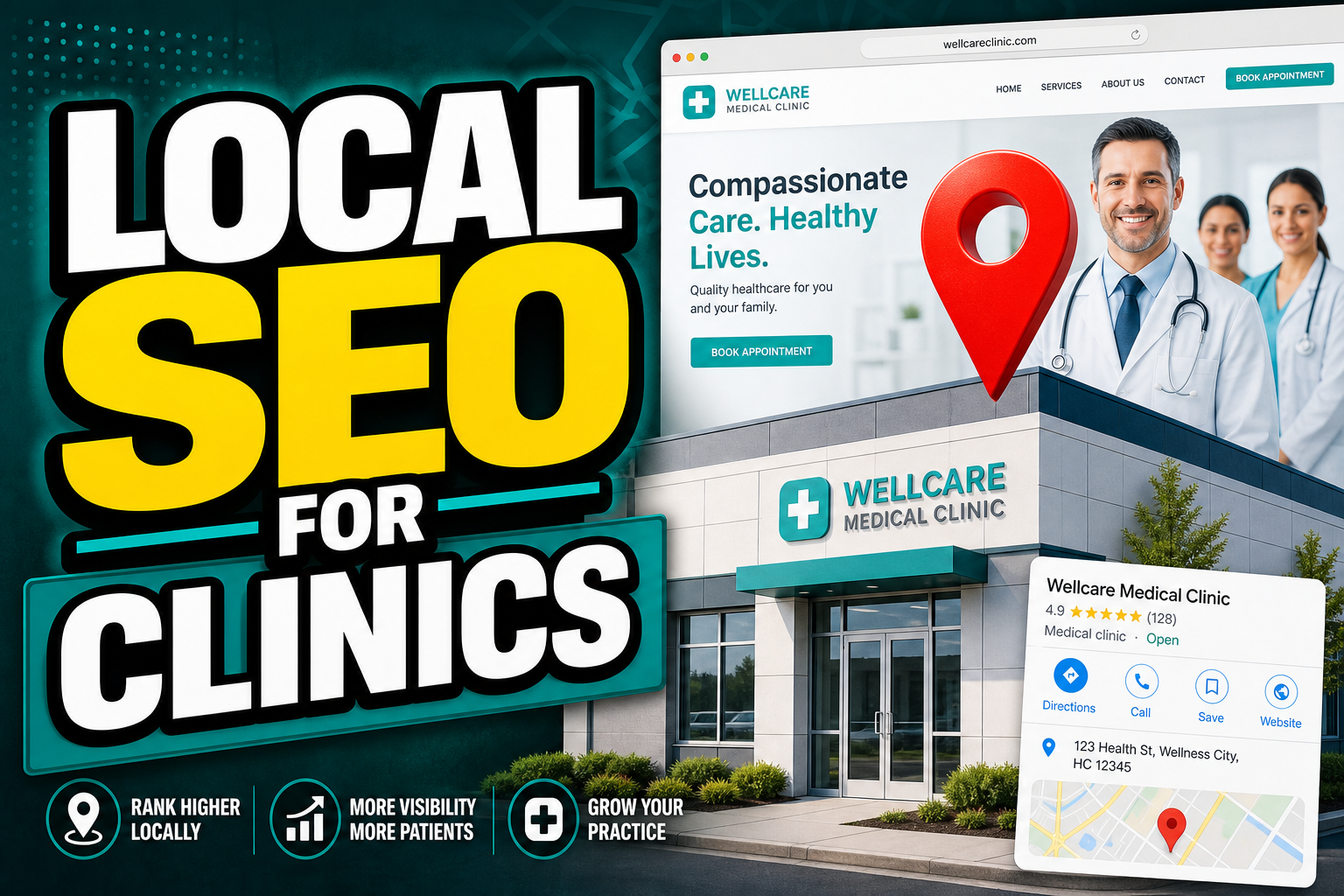
For medical practices, local SEO isn't just important — it's existential. When a patient searches for "doctor near me" or "[treatment] in [city]," the practices that appear in Google's Map Pack and local organic results get the calls and bookings. Everyone else is invisible.
At Marceline Studios, we implement local SEO strategies for med spas, IV therapy clinics, ketamine centers, and healthcare practices across the US. In this guide, we break down the complete local SEO playbook for medical practices in 2026.
Understanding Local Search for Healthcare
Healthcare has among the highest local search intent of any industry. Consider these search patterns:
- "dermatologist near me" — 246,000 monthly searches
- "urgent care near me" — 1.5M monthly searches
- "[treatment] in [city]" — Thousands of location-specific variations
Over 80% of healthcare searches have local intent (Source: Think with Google, 2025). This means your SEO strategy must be built around local signals. For med spas and IV therapy clinics specifically, med spa local SEO is the difference between a fully booked schedule and empty appointment slots.
Step 1: Google Business Profile Optimization
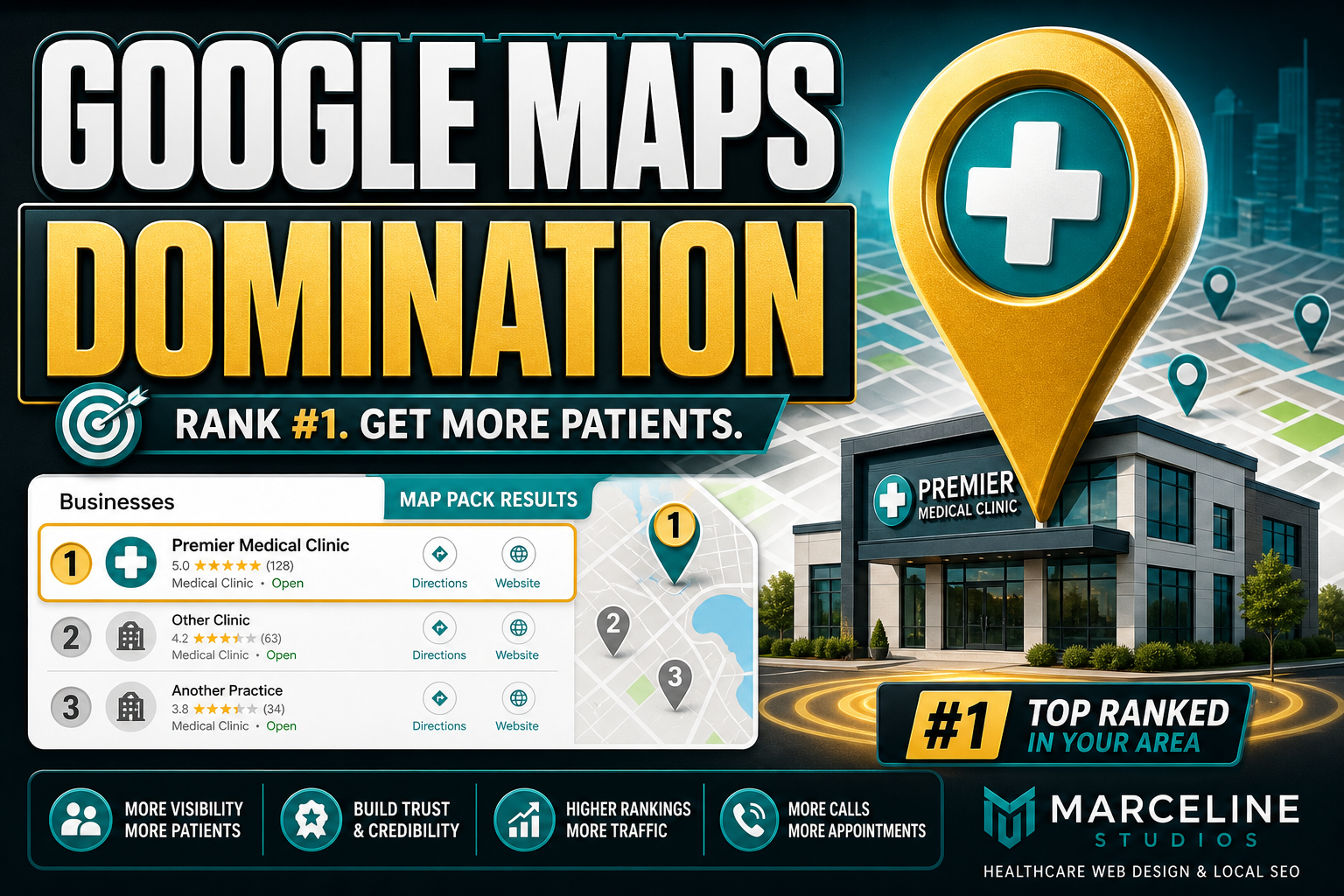
Your Google Business Profile (GBP) is the single most important asset for local SEO. It determines whether you appear in the Map Pack — the top 3 local results that appear with a map above standard search results.
Complete every field:
- Business name (exact match to your practice name)
- Primary category (e.g., "Medical Spa," "Internal Medicine Physician")
- Secondary categories for additional services
- Business description with target keywords
- Services list with descriptions
- Hours of operation (including special hours for holidays)
- Appointment link
- Insurance accepted
- Photos and videos
Post weekly: Google rewards active profiles. Post about:
- New treatments or services
- Staff introductions or achievements
- Health tips and seasonal wellness advice
- Special offers or membership plans
Respond to every review: Review response rate and speed are ranking factors. Respond to positive reviews with gratitude and negative reviews with professionalism. Always within 24 hours. For med spas and IV therapy clinics, review management is a core component of med spa local SEO.
Step 2: Citation Building & NAP Consistency
A "citation" is any online mention of your practice's Name, Address, and Phone number (NAP). Google uses citation consistency as a trust signal for local rankings.
Priority citation sources for healthcare:
- Healthgrades, Vitals, WebMD, Zocdoc, RateMDs
- Yelp, Yellow Pages, Better Business Bureau
- Apple Maps, Bing Places, Facebook
- State medical board directories
- Insurance provider directories
- Local chamber of commerce
Consistency is key: Your practice name, address, and phone number must be identical across every listing. Even small variations (St. vs Street, Suite 100 vs Ste. 100) can confuse Google.
Step 3: Location Pages
If your practice has multiple locations — or even if you have one — a dedicated location page is essential. For example, if you operate across major cities, you should have dedicated pages for New York, Miami, Los Angeles, Austin, Dallas, and Chicago. This is fundamental to both healthcare web design and local SEO.
What to include:
- Full address with embedded Google Maps
- Phone number linked for click-to-call on mobile
- Office hours presented clearly
- Driving directions and parking information
- Unique content about that specific location
- Staff bios for providers at that location
- Patient testimonials from that location
- LocalBusiness schema with geo-coordinates
Important: Each location page must have unique content. Never duplicate content across location pages with only the city name changed.
Step 4: Review Generation Strategy
Reviews are one of the strongest local ranking factors. Practices with more reviews and higher ratings consistently outrank competitors.
Strategies for generating reviews:
- Ask patients directly after a positive experience
- Send follow-up emails or SMS with a Google review link
- Make it easy: a QR code in your office linking to your review page
- Never offer incentives for reviews (violates Google's guidelines)
- Train staff to mention reviews during checkout
HIPAA-aware review strategy: Design your review request process to avoid referencing PHI. Never reference specific treatments, diagnoses, or outcomes in your review responses. Keep responses general — thank the patient, acknowledge their visit, and invite them back. If a patient mentions protected health information in their review, do not confirm or discuss it in your public response. A healthcare web design agency experienced in HIPAA-aware marketing practices can help you set up compliant review workflows.
How many reviews do you need? Aim to match or exceed your top local competitors. In most markets, 50-100+ Google reviews with a 4.5+ rating provides a significant competitive advantage for med spa local SEO.
Step 5: Local Content Strategy
Create content that targets local search intent:
- "[Treatment] in [city]" articles
- "Best [specialty] in [city]" guides
- Local health event coverage
- Community involvement posts
- Seasonal healthcare tips with local relevance
This content supports your local authority and creates additional entry points for patients searching in your area. For med spas and IV therapy clinics specifically, local content should target treatment-specific and location-specific long-tail keywords that drive patient acquisition.
Measuring Local SEO Success
Track these metrics monthly:
- Map Pack visibility — Are you in the top 3 for target keywords?
- GBP insights — Views, clicks, direction requests, phone calls
- Organic local traffic — Visitors from location-specific queries
- New patient bookings attributed to organic search
- Review velocity — New reviews per month
Local SEO is a compound investment. Results build over time as your practice accumulates reviews, citations, and local content authority. Start with the fundamentals in this guide, be consistent, and the results will follow.
Need help implementing local SEO for your medical practice? Book a free strategy call with our healthcare digital marketing agency team.
Frequently asked questions
Local SEO is critical for healthcare — over 80% of healthcare searches have local intent. Patients search for doctors, treatments, and clinics near them. Appearing in Google's Map Pack can dramatically increase bookings.
Claim and fully optimize your Google Business Profile, build NAP-consistent citations across healthcare directories, generate patient reviews, and create location-specific pages with LocalBusiness schema.
Aim to match or exceed your top local competitors. In most markets, 50-100+ Google reviews with a 4.5+ rating provides a significant competitive advantage in local search results.